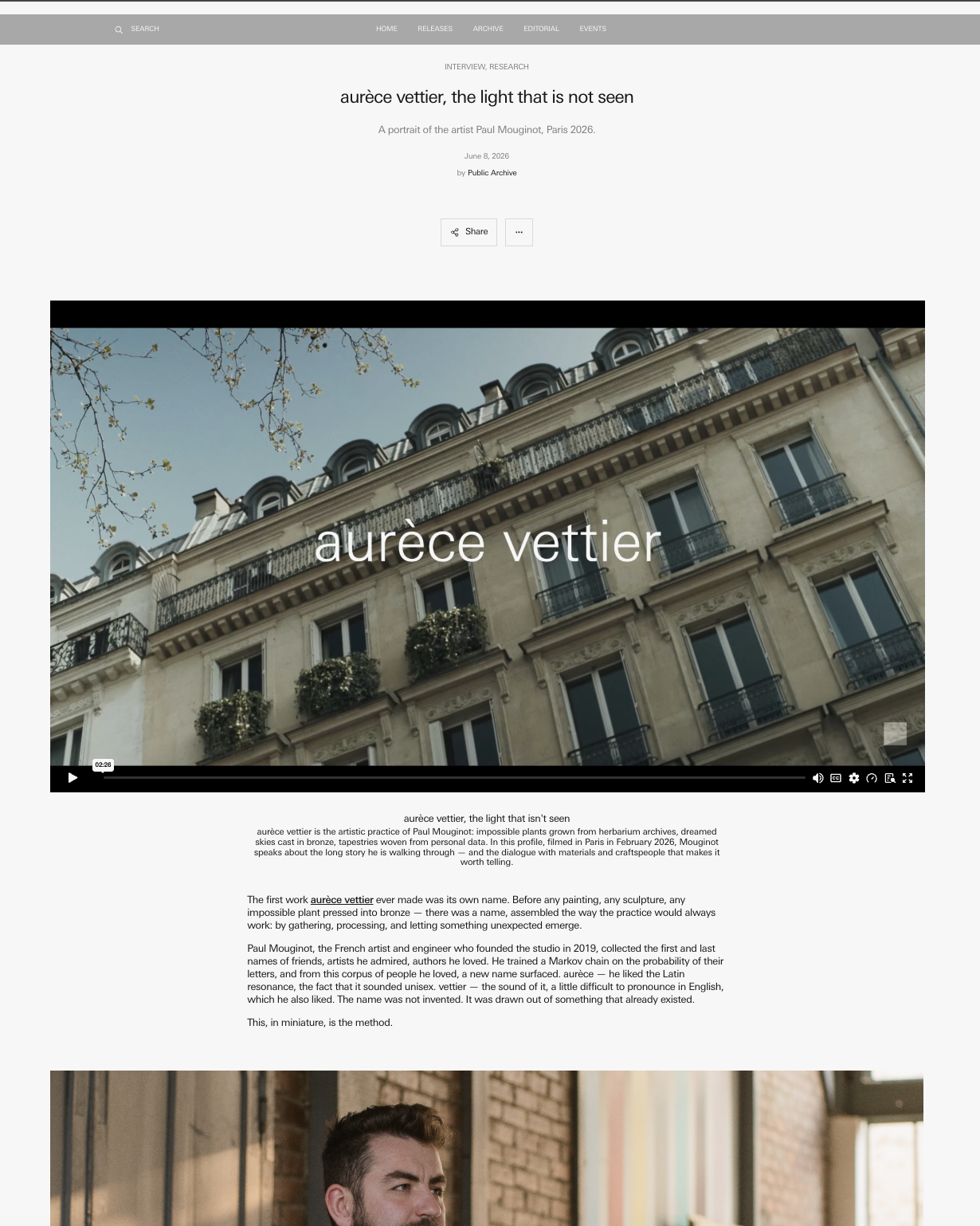
The first work aurèce vettier ever made was its own name. Before any painting, any sculpture, any impossible plant pressed into bronze — there was a name, assembled the way the practice would always work: by gathering, processing, and letting something unexpected emerge.
Paul Mouginot, the French artist and engineer who founded the studio in 2019, collected the first and last names of friends, artists he admired, authors he loved. He trained a Markov chain on the probability of their letters, and from this corpus of people he loved, a new name surfaced. aurèce — he liked the Latin resonance, the fact that it sounded unisex. vettier — the sound of it, a little difficult to pronounce in English, which he also liked. The name was not invented. It was drawn out of something that already existed.
This, in miniature, is the method.
Mouginot came up through AI systems development at a particular moment — 2019, the year he also visited the Venice Biennale, where the prevailing mood, as he remembers it, was "quite pessimistic." Many artists were saying, in one form or another, that we are doomed. He left thinking the opposite: that with AI, with an excitement about craftsmanship, with the stories he wanted to tell, it might be possible to propose hypotheses of the future that were something other than elegies. aurèce vettier was founded as a kind of laboratory for those hypotheses.
The practice operates through what Mouginot describes as an alphabet — two axes that can be combined, extended, and explored across a lifetime of work without exhausting their possibilities. He is explicit that he feels no pressure toward the recognisable output contemporary art sometimes demands of its practitioners, the compulsion to become one's own brand. What he is building instead is a story, slowly unfolding, that he compares to a journey in the mountain. A forever journey, with many sidetracks.
The first axis is what he callssur-nature. It began when he started feeding generative adversarial networks millions of herbarium plates — dried flowers on paper, preserved in natural history museums, the kind of images that record what was once alive. Even trained on millions of examples, what the models returned were impossible plant shapes. Forms that could not survive in the real world. Flowers that have no biological right to exist.
He found this deeply moving. "It looked as if nature had decided to commit suicide," he says. "Maybe that is what nature could do when it witnesses what humans do to it." There is nothing sentimental in the way he says this. The impossible plants are not a lament. They are a reminder — and a warning — rendered in forms that carry both the strangeness of the machine and the weight of something we almost recognise.
The second axis,sur-réalité, creates the world in which this impossible nature appears. Since childhood, Mouginot has dreamed of atmospheric phenomena: comets, exploding stars, several moons in the sky at once, a world entering into resonance. His work depicts figures crossing forests on initiatory journeys, the sky above them flamboyant with events that may or may not be real. He is, he says, obsessed with the star Betelgeuse — which could explode within our lifetimes, or might not. The uncertainty is part of the point.
One memory returns to the work again and again. When Mouginot was seven, his father woke him late one evening and walked him up a hill near their house in the French mountains. The fields were almost empty, the sky completely clear. The Hale-Bopp comet was taking a huge part of the sky. "I never forgot it," he says. "I am not even sure we will see a comet like that again in our lives."
When he goes back to that hill now, the fields have been replaced by buildings, the sky heavily polluted by light. The comet, if it returned, would not be the same poetic sight. Part of what drives the work is this: if we have reached a point where we pollute our sky so much that we cannot see beautiful objects in it, perhaps it is time to find this beauty another way — and, in finding it, to create the desire to go back to these sights in real life.
The translation from data into matter is not, Mouginot insists, data visualisation. "The job of an artist is not always to visualise," he says. "It is more about digestion." The distinction matters to him. A visualisation is transparent. A digestion is something else — it passes through a body, and what comes out carries the mark of that passage.
In practice, this often means bronze. Mouginot uses a technique called lost-wood casting: he gathers data, processes it into three-dimensional models, then takes those models into a forest to find real branches that fit the form. He assembles a wooden mock-up, which goes into the foundry — not into a mould, as in lost-wax casting, but directly into the plaster cylinder. In the oven, the wood vaporises into steam. The bronze is cast. The mock-up is lost. Each piece is unique by necessity, by design. You go from potential abundance into something extremely scarce.
Tapestry operates by a different logic but a related discipline. Mouginot describes it in mathematical terms as a projection — moving from a space of many dimensions into one with fewer, choosing your angle. Working with a Jacquard loom, he is limited to sixteen thread colours. Sometimes, working with the craftspeople, he stretches that: by stopping the shuttle mid-weave and changing the thread, they have pushed from sixteen to twenty-four — enough to produce what in French is called acamaïeu, a set of shades fine enough to render the subtleties of a sky at dusk.
"That dialogue is why I do this job," he says. "Being an artist is such a difficult job — it is not even a job, in a way. Everything I do, I do for that type of dialogue."
He is careful about how he describes his use of AI, and careful about which tools he reaches for. He does not use AI for its generative capabilities. We are already, he observes, in a context of over-offer — more content than anyone can absorb, generated faster than it can be read or seen. What interests him is the digestive capacity of the models: their ability to look within a body of material and surface what was always there but not yet visible. He calls this "the light that is not seen."
He fine-tunes models on his own data — childhood images, texts he wrote when he was younger, images from his phone — giving a strong personal bias, downstream, to everything the models produce. What comes out carries colours and shapes he already knows, estranged just enough by the machine to become interesting. "In business applications," he says, "you try to remove those personal shapes. In art, it is exactly the opposite."
His lineage here is the Hungarian artist Vera Molnar, who worked with algorithms in the 1960s and 70s and called them her slaves — not partners, not authors. She picked what she wanted from what they proposed, guided by intuitions formed through a life spent with art history. Mouginot is explicitly in that school. He is not building the perfect system so the system can become the work. He is here to extract the interesting elements and recompose them.
He also maintains a quiet loyalty to GANs — generative adversarial networks — at a moment when the broader field has largely moved to diffusion models and text-to-image generation. With a GAN, you do not prompt. You assemble a dataset, and the model produces a kind of quintessence: images that are a little like your data, but not exactly. You can be surprised by what emerges. "There are only a few artists still interested in GANs," he says. "We happen to talk to each other, and we share the feeling that their potential has not been fully exploited." He also loves the lower resolution of the older models. The slight crankiness, the blur that the eye must meet halfway — it helps an audience appropriate the work, fill in the uncertainty with their own memories.
When a work is finished, Mouginot brings it home and lives with it for a few days, sometimes weeks. Sometimes he realises a detail needs to change — a branch removed from a sculpture, a frame adjusted. At some point an equilibrium is reached. You feel: okay. That is it. It can go.
What he hopes an audience feels when a work arrives, he will not specify. The encounter is always personal, and he has learned not to pre-write it. His dream, when a show opens, is to visit the galleries incognito — to listen while strangers begin telling each other extremely personal stories prompted by what they have seen. At his exhibition at macLYON, and later at Jeu de Paume, he did exactly this. Sometimes, he says, the conversations were even more fascinating than the work itself. They were the result of the encounter.
As for the longer horizon: he wants to find, as the studio grows, a working modality in which placing works into collections helps repair the real world in some concrete, measurable way. Connections with organisations that restore ecosystems, return land to its original state, bring birds and animals back. When a sculpture is placed somewhere, a certain area of forest is returned. He calls it a dream more than a vision. But it is the kind of dream he intends to make true.