Skip to content
aurèce vettier
English
Français
日本語
한국어
Русский
中文
العربية
Monographs
Books
Periodicals
Research papers
Curatorial texts
Home
Works
Collaborations
Exhibitions
Biography
Bibliography
News
Contact
← Periodicals
‹ Previous
Next ›
2024
Transzformersz-Madeleine
Artmagazin.hu
Author: Cserna Endre
Hungarian
Download full article (PDF) →
Visit article page →
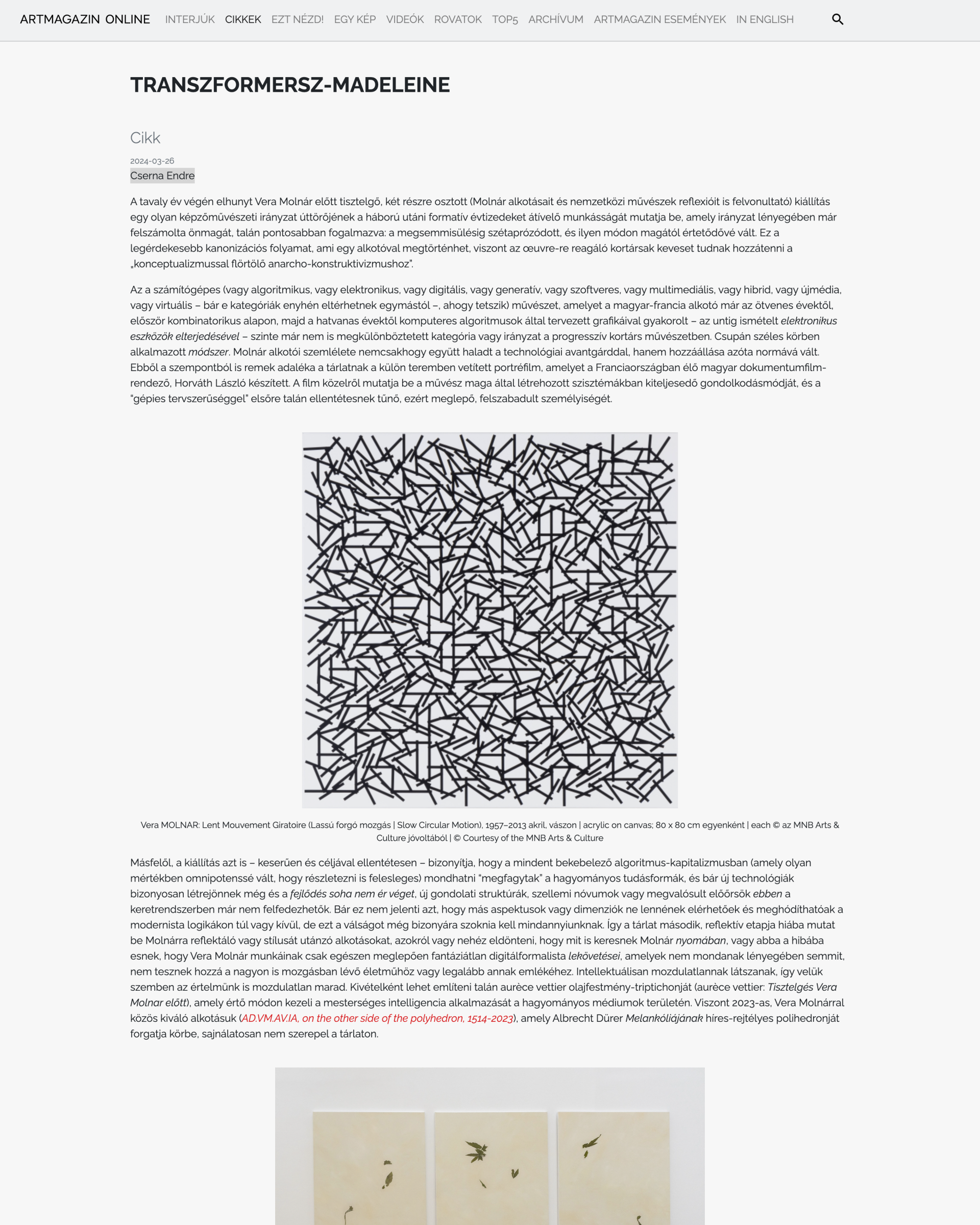
Transformers-madeleine Article 2024-03-26 Endre Cerna The two-part exhibition, which pays tribute to Vera Molnár, who passed away at the end of last year, presents the work of the pioneer of a visual art movement spanning the formative decades of the post-war period, which has essentially eliminated itself, or perhaps more accurately: fragmented to the point of annihilation, and thus become self-evident. This is the most interesting process of canonization that can happen to an artist, but contemporaries who respond to the œuvre have little to add to the “anarcho-constructivism flirting with conceptualism.” The computer (or algorithmic, or electronic, or digital, or generative, or software, or multimedia, or hybrid, or new media, or virtual – although these categories may differ slightly from each other – as you like) art, which the Hungarian-French artist practiced since the 1950s, first on a combinatorial basis, and then from the 1960s with his graphics designed by computer algorithms – with the spread of electronic devices that have been repeated until now – is almost no longer a distinct category or trend in progressive contemporary art. It is simply a widely used method . Molnár's creative approach not only progressed with the technological avant-garde, but his attitude has since become the norm. From this perspective, the portrait film screened in a separate room, made by the Hungarian documentary film director László Horváth, who lives in France, is also a great addition to the exhibition. The film closely presents the artist's way of thinking, which is fulfilled in the systems he created, and his liberated personality, which at first seems to contradict "mechanical design", and is therefore surprising. Vera MOLNAR: Lent Mouvement Giratoire (Slow Circular Motion), 1957–2013 acrylic on canvas; 80 x 80 cm each © Courtesy of the MNB Arts & Culture Vera MOLNAR: Lent Mouvement Giratoire (Slow Circular Motion), 1957–2013 acrylic on canvas; 80 x 80 cm each © Courtesy of the MNB Arts & Culture On the other hand, the exhibition also proves – bitterly and counterintuitively – that in the all-consuming algorithmic capitalism (which has become so omnipotent that it is unnecessary to go into detail), traditional forms of knowledge have become “frozen”, and although new technologies will certainly be created and development will never end , new thought structures, intellectual novums or realized outposts can no longer be discovered within this framework. Although this does not mean that other aspects or dimensions are not accessible and can be conquered beyond or outside modernist logics, we must all get used to this crisis. Thus, the second, reflective stage of the exhibition presents works that reflect on Molnár or imitate his style, but it is either difficult to decide what they are looking for in Molnár's footsteps , or they fall into the mistake of seeing them as surprisingly unimaginative digital formalist imitations of Vera Molnár's works , which essentially say nothing, do not add to the very moving oeuvre or at least to its memory. They seem intellectually immobile, so our intellect remains immobile in comparison with them. An exception might be Aurèce Vettier's oil painting triptych (Aurèce Vettier: Homage to Vera Molnar ), which understandably handles the application of artificial intelligence in the field of traditional media. However, their excellent work from 2023, together with Vera Molnár ( AD.VM.AV.IA, on the other side of the polyhedron, 1514-2023 ), which revolves around the famous and mysterious polyhedron of Albrecht Dürer's Melancholy , is unfortunately not included in the exhibition. aurèce vettier: Tribute to Vera Molnar, 2024 The exhibition is another demonstration that the European or transatlantic modernist tradition, whose last great era Molnár fits into, cannot be continued along its own established strategies and it is impossible to attach a curatorial mission to it. It cannot be said to be contemporary, but in any case newly made, similar works in the artistic environment of today's post-digital and, incidentally, post-gender, post-human, post-truth, etc. intellectual trends and trends. Not to mention the fact that Vera Molnár's works fit into these better, and are more contemporary , even retrospectively , than most of the works of those who pay tribute to her in the exhibition. The practice of a female artist who emigrates from the periphery to the center, but who transcends this problematic dichotomy, seeks new, interdisciplinary and scientific creative paths in the traditionally masculine environments of informatics and programming, and who treats tradition as a methodical starting point, makes a more energetic, up-to-date impression today and is more forward-looking than a group of 100 squares or a retrofuturistic video game projection, since Molnár did not sacrifice her elegantly neutral, conceptualist and constructivist spirit in her visual design for the suggestive and fashionable digital experience world of technological spectacles. Vera MOLNAR: Squaring the Circle, 1962–1964 oil on canvas; 110 x 110 cm © Courtesy of the MNB Arts & Culture In Search of Vera Molnar - Vera Molnar's Works and Contemporary Reflections Ludwig Museum, Budapest Curators: Richard Castelli, Zsófia Máté February 10 – April 14, 2024.