aurèce vettier: The Making of a Lifelong Narrative
Artists Corner
18 Jan, 2026
Written By Anika Meier
Artificial intelligence is often framed as a technology of acceleration, automation, and extraction. In aurèce vettier’s work, it becomes something else entirely: a slow instrument for introspection, memory, and care. Rather than producing images at scale, vettier uses AI as a means of returning to what is fragile, partial, and unresolved, treating the machine not as an author but as a mediator between inner life and material form.
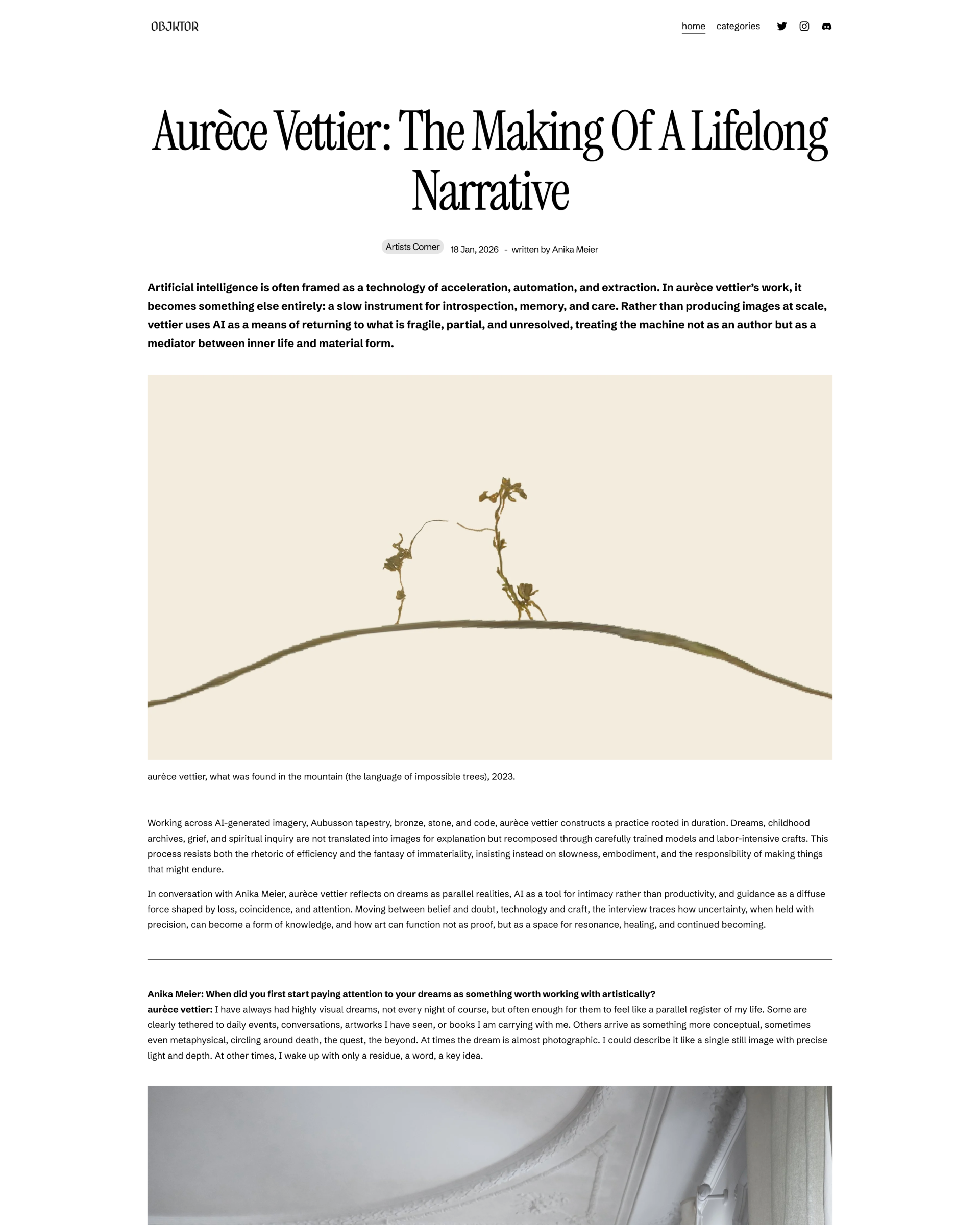
aurèce vettier, what was found in the mountain (the language of impossible trees), 2023.
Working across AI-generated imagery, Aubusson tapestry, bronze, stone, and code, aurèce vettier constructs a practice rooted in duration. Dreams, childhood archives, grief, and spiritual inquiry are not translated into images for explanation but recomposed through carefully trained models and labor-intensive crafts. This process resists both the rhetoric of efficiency and the fantasy of immateriality, insisting instead on slowness, embodiment, and the responsibility of making things that might endure.
In conversation with Anika Meier, aurèce vettier reflects on dreams as parallel realities, AI as a tool for intimacy rather than productivity, and guidance as a diffuse force shaped by loss, coincidence, and attention. Moving between belief and doubt, technology and craft, the interview traces how uncertainty, when held with precision, can become a form of knowledge, and how art can function not as proof, but as a space for resonance, healing, and continued becoming.
Anika Meier: When did you first start paying attention to your dreams as something worth working with artistically?
aurèce vettier: I have always had highly visual dreams, not every night of course, but often enough for them to feel like a parallel register of my life. Some are clearly tethered to daily events, conversations, artworks I have seen, or books I am carrying with me. Others arrive as something more conceptual, sometimes even metaphysical, circling around death, the quest, the beyond. At times the dream is almost photographic. I could describe it like a single still image with precise light and depth. At other times, I wake up with only a residue, a word, a key idea.
Portrait of aurèce vettier by Romain Ricard.
When I founded aurèce vettier in 2019, I first began by constructing a sur-nature, an impossible botanical world, through early AI tools such as GANs, and by giving these forms a body through bronze and other crafts. Very quickly, I felt the need to situate this nature inside a wider world, a sur-réalité resonating with ours.
By combining text-image approaches such as CLIP with GAN-based models, and by tuning these tools on my personal archive, from childhood photographs to what lives today on my phone, I gradually built a visual language that felt intimate and consistent. That became the basis for translating dreams, and then slowly linking them together, which led to solo shows such as Circular Ruins (2022) or le travail des rêves (2024).
AM: You describe AI as a tool for introspection. What does it allow you to access that other tools don’t?
av: For me, it is introspective precisely because I do not use off-the-shelf tools. I spend a long time training, fine-tuning, and calibrating my models so they carry the meaning of my own data, images, texts, and references accumulated since childhood.
I grew up in the mountains. I walked for hours in forests and high-altitude paths, surrounded by plants, trees, and animals, and I kept childhood notebooks where I meticulously wrote down what those animals “told” me: birds, hedgehogs, cattle. Over time, I developed a private ecosystem of colors, motifs, and recurring concerns. Moreover, certain books have altered the architecture of my life, and I live with their echoes every day.
When I feed these materials into my tools, the models often return forms that have always been near me, but only in filigree, present yet not directly visible to my own consciousness. AI becomes, for me, a kind of flavor enhancer, a percolator of the story I am deploying, a spectral reader that reveals the light that cannot be seen. Of course, there are other paths toward that zone, such as meditation, automatic writing, monastic life, and altered states, but this is the procedure that fits my temperament and the way my imagination is built.
AM: Many people use AI to generate things quickly. Your process sounds slow and careful. Why is slowness important to you?
av: Because I live largely inwardly, and I do not feel an obligation to accelerate or to speak constantly. Even when I name bodies of work, I do not really function in neat series. Most of what I create is interconnected, describing the same world in vibration with ours, unfolding at the same pace as my own existence.
“I believe words become alive when they are spoken, and artworks become alive when they leave my studio. I want them to have the best chance of survival, and that requires care, silence, and time.” – aurèce vettier
There is also a very concrete reason. I work with processes that are inherently slow: training models, casting bronze, weaving Aubusson tapestries, assembling pietra dura works. Much of this is done alone or with small teams, and much of it depends on artisanship, delays, weather, and material constraints. And despite following technological advances closely, I still work with certain models and methods that date back to 2018 or 2019, because they belong to a stable ecosystem I have built over years.
“Slowness is not a posture, but rather the tempo of a lifelong narrative being written through matter.” – aurèce vettier
aurèce vettier, la traversée de la forêt, installation at Museum of Contemporary Art of Lyon (macLYON), Bronze sculptures, Aubusson tapestries, Oil paintings, all derived from AI-generated images, 2025. Curated by Marilou Laneuville, Photo: Romain Darnaud.
AM: You work with very personal archives, including childhood images. Was there hesitation before feeding these into a machine?
av: No, because very early on I understood that these tools could return what felt most familiar to me, not only visually but also conceptually. They help me retrieve my recurring forms, my obsessions, the inner weather I have carried across time, whether in text, poetry, images, or 3D. What matters is that the machine does not simply reproduce the archive. It digests it and recombines it, creating a kind of transmission, a handover, where intimacy becomes material rather than confession.
At the same time, this personal origin does not lock the work into autobiography. On the contrary, because the images are recomposed through this algorithmic distance, the visitor often finds space to attach their own memories, emotions, and impressions. I experienced this very strongly through the mediation feedback around the crossing of the forest at the Musée d’Art Contemporain de Lyon (macLYON) in 2025. It quite reassured me. I need sincerity as a starting point, but I am equally passionate about the fact that each person can appropriate the work in their own way.
AM: How does it feel to see fragments of your own life recombined in ways you didn’t consciously choose?
av: There is a great deal I do not “choose” in the recombination itself. When I decide that a proposal is valid or not, it can feel like a form of letting go, an instinctive selection. Yet that instinct is not random. It is precisely where the artist’s inner garden speaks. This was one of the most powerful teachings of my collaboration with Vera Molnár in 2023, under the curation of Vincent Baby. The subjective decision, the smallest yes or no, becomes an authorship of sensibility.
Sometimes I generate images from a dream, make these intuitive choices, and only days, weeks, or months later, through a coincidence, a conversation, a synchronicity, I suddenly understand what was at stake. In those moments, I often feel a shiver, surprise mixed with recognition. It makes me curious, it keeps the work open, and it pushes me to continue, not as production, but as exploration, like following a thread in a dark forest and realizing it was connected to something much older in me.
AM: At first, you thought the luminous figures in your dreams were ghosts. What made you reconsider that interpretation?
av: When I was preparing the exhibition at macLYON in late 2024, I began to have many dreams, sometimes closer to nightmares, in which I encountered bluish entities or moved toward them as if pulled by a gravity I did not understand. I assumed they were ghosts because fear was present. Still, I tried to represent them as faithfully as possible, and they appear notably in the monumental Aubusson tapestries produced for that context.
At the same time, I was thinking a lot about death and the beyond, and I started reading widely, including testimonies of near-death experiences and religious texts describing angels and their hierarchies. Slowly, the interpretation shifted. What if these luminous figures were not haunting but guiding, souls more advanced than ours, seraphim perhaps, present to reassure us, to accompany us, to show how to continue the ascent. I do not claim certainty, but the work moved from fear toward a form of attentive listening, and that change reshaped the emotional temperature of the images.
AM: Guidance is a recurring theme in your work. Do you think this need for guidance has become stronger in recent years?
av: I have always had a dense interior life, which has made me happy and relatively autonomous, but it can also be solitary. It probably explains why I sought guides very early. As a teenager, I thought I might become a monk. Later, entering professional life in an increasingly turbulent world, I looked for mentors and found fewer than I hoped, perhaps because that era is fading. Guidance became less an external figure and more a diffuse presence: signs, coincidences, books arriving at the right moment, encounters that shift something inside you.
When my younger sister passed away, I began to notice signs that felt like messages, in ways I cannot fully rationalize. That has accompanied my grief and has quietly entered the work. The yellow butterflies that recur in my dreams are part of this. Guidance, for me, is not obedience to an authority. It is a way of remaining porous to the world and to what exceeds us, especially when language fails. In that sense, yes, the need has intensified, because the world itself feels increasingly unstable, and we are all searching for a form of orientation that does not become dogma.
aurèce vettier, aurorium graminis (after transmutation into peradam), Bronze sculpture from AI-generated forms, gilded with gold leaf and palladium leaf, 90 cm x 50 cm x 50 cm, Photo: Genevieve Garruppo.
AM: You move from AI-generated images to tapestries, bronze, and stone. What does it mean for you to translate something immaterial into something lasting?
av: I often ask myself: will some of my work outlast me? Bronze sculptures, hard-stone panels, poems embedded in the blockchain? I do not know. But it is crucial for me to choose materials, technologies, and processes that can withstand time, that can resist disappearance. This is why craft matters so much in my practice. Far from nostalgia, it is a strategy of duration, a refusal to let digital images remain weightless, infinitely reproducible, and therefore easily forgotten.
Sometimes I even fantasize about placing a work in a space probe, the way Laurie Spiegel’s music travels with Voyager. In five billion years, when the sun vaporizes the Earth, a fragment of art could still drift in the universe. I find that image profoundly moving. It gives a different scale to what we do in a studio.
“Tapestry, bronze, stone, and code are different answers to the same question: how can an inner vision, as volatile as a dream, become a form of matter that continues to speak after we are gone?” – aurèce vettier
AM: Your work sits somewhere between belief and doubt. Do you think art is a good place to hold uncertainty?
av: I am deeply French, and whether I like it or not, I am steeped in a culture of doubt. I see doubt as a defense against dogma, and against the kind of dehumanization that comes from over-certainty. Today, it is almost a survival approach. Art can hold contradictions without resolving them. It can host belief without turning it into ideology. It can let a viewer feel something real without having to name it, prove it, or reduce it to a thesis.
In my work, uncertainty is a space of resonance. Dreams are uncertain by nature, memory is uncertain, and the image itself is uncertain, as Baudrillard perfectly demonstrated, forever hovering between truth and simulacrum. I do not try to close that gap. I try to inhabit it with precision and care, so that the viewer can enter it too, and perhaps recognize their own doubts as a form of intelligence rather than weakness.
aurèce vettier, the city of angels (study) from the city of angels, AI-generated image, AI model trained on the childhood photos of the artist.
AM: You train your own AI models instead of relying on ready-made tools. Is that about control, intimacy, or trust?
av: It started as a habit. I began working with AI before the rise of ready-made tools, so building my own pipelines was simply the natural way in. Over time, it became essential for consistency. I want an aesthetic and conceptual continuity that is not dependent on the shifting policies, updates, and stylistic drift of commercial systems. I construct a stable visual ecosystem, almost like a studio palette, something that evolves slowly with me.
It is also about energy and responsibility. Running models locally, only when needed, is often more restrained than outsourcing everything to massive infrastructures. But above all, it is intimacy. I could not give up tools that are tuned so closely to my archive, my colors, my personal memes.
AM: AI is often discussed in terms of productivity and efficiency. Your work seems to resist that language. Why?
av: Because what interests me most is bricolage. The humble, experimental act of making, assembling, testing, failing, trying again. I do not feel the need to scale or to speak in the language of startup acceleration. I would rather deepen than expand, connect distant disciplines, pursue higher quality and tighter interconnections. Photography can be used to visually represent and sell thousands of products online, but it can also reveal rare, intimate instants. I believe AI is similar. Beyond productivity narratives, it can be bent, twisted, and reoriented toward forms of poetic research.
“In my studio, AI is a way of introducing anomaly, rupture, and accident into the image, and then negotiating that accident through material processes that are slow and irreversible. The image thus becomes a site of friction between the computational and the handmade, between abundance and scarcity, between the instant and the permanent.” – aurèce vettier
AM: Do you feel that working with AI has changed how you think about memory, or even about your own past?
av: Memory has always been one of my great territories, but AI gave me a new operating mode for exploring it. Writers such as Michel Leiris, Georges Perec, Primo Levi, Simone de Beauvoir, and Haruki Murakami each developed intimate architectures for speaking about the past. For me, AI becomes another architecture, not replacing literature or lived experience, but offering a different kind of mirror, one that reflects through recombination rather than narration.
When I work with models trained on my archives, the past becomes less a fixed sequence and more a living material, something that can be folded, distorted, resurfaced unexpectedly. It changes the emotional texture of memory. It reveals that what we call “my past” is not stable; it is a field of fragments constantly rewritten by dreams, by present events, by loss, by desire.
“The machine does not tell me what happened. It shows me how the past continues to act, beneath consciousness, shaping the images I am still becoming.” – aurèce vettier
AM: You describe your practice as a long-form narrative unfolding over a lifetime. How do you decide when a chapter is finished?
av: René Daumal writes in Mount Analogue that “the mountain is the bond between Earth and the sky.” I was born in the mountains, and a long hike as a metaphor for existence has always felt natural to me. So I imagine that after beginning the crossing of the forest, I will continue the exploration until my death. Chapters do not end because I decide they are complete. They shift because life shifts, because a rupture forces a new direction, a new tool, a new vocabulary.
I moved into the assembly of alphabets, impossible herbaria, dreams, and botanists’ writings after an event I am still not ready to recount. And after the death of my younger sister, I felt that the equipment, the language, the crafts, and the models had become sufficient to attempt the crossing of the forest. A chapter closes when a new necessity appears, when the work no longer answers the question that life is asking. Then I keep walking, and the narrative adjusts to the new terrain.
aurèce vettier, a family of souls encountered in Singapore (study) from the city of angels, AI-generated image, AI model trained on the childhood photos of the artist.
AM: Do you think AI can be used for healing, or is that something that only happens on the human side?
av: Absolutely. I am convinced that these technologies, especially artificial intelligence, when prepared and used with a high level of refinement, can help us heal. As part of the catalogue of Circular Ruins (2022), I even invited my psychologist to talk about this, because I wanted to treat it as a serious topic, not a vague metaphor. AI can help people who have built emotional fortresses around themselves. By translating feelings, situations, and inner images into visual form, it can offer one key, not the only one, but one possible opening into those structures.
For me personally, this is exactly why I use it. I use AI for introspection, to go deeper, to metabolize grief, fear, and longing, to transform them into forms that can be looked at, shared, and eventually carried.
“Healing is human, of course, but tools can facilitate the conditions of healing. They can create distance, clarity, and unexpected passages, where language alone sometimes fails.” – aurèce vettier
AM: If someone looks at the city of angels and can’t quite explain why it resonates, would that be the ideal response?
av: Silence, and all this will make sense in due course.
AM: Thank you, Paul!
aurèce vettier, a seraphim guiding a soul in the heart of the night (study) from the city of angels, AI-generated image, AI model trained on the childhood photos of the artist.
BIOS
aurèce vettier is an artistic entity founded by Paul Mouginot (b. 1990) that explores the interplay of artificial intelligence, memory, and ultracontemporary craftsmanship. Centered on the concepts of sur-nature and sur-réalité, the studio creates unique works -bronze sculptures, tapestries, paintings- often in collaboration with master artisans. Exhibited at Museum of Contemporary Art of Lyon (macLYON), the Jeu de Paume, or with NVIDIA at GTC Paris, aurèce vettier bridges traditional collecting and technological exploration.
Since 2019, aurèce vettier has gained recognition for its poetic approach to AI, rooted in personal data and speculative narratives. In 2025, aurèce vettier was a finalist of Lumen Prize in the Still Image Award and Hybrid Award.
Anika Meier is a writer and curator specializing in digital art. She lives and works in Berlin, Germany, and teaches at the University of Applied Arts in Vienna (Class of UBERMORGEN, Department of Digital Art). She is the co-founder of The Second-Guess, a curatorial collective based in Berlin and Los Angeles that explores the relationship between humans and technology.
INFO
aurèce vettier’s collection the city of angels will be available to collect on objkt.com on 27 January 2026.
The exhibition I’ve missed our conversations. On AI, Emotions, and Being Human, curated by Anika Meier for The Second-Guess, is on view from 27 January to 12 March 2026 at Schlachter 151 by OOR Studio in Berlin. In collaboration with Numéro Berlin and Fräulein, and powered by the Tezos Foundation. Find more information about the exhibition here.