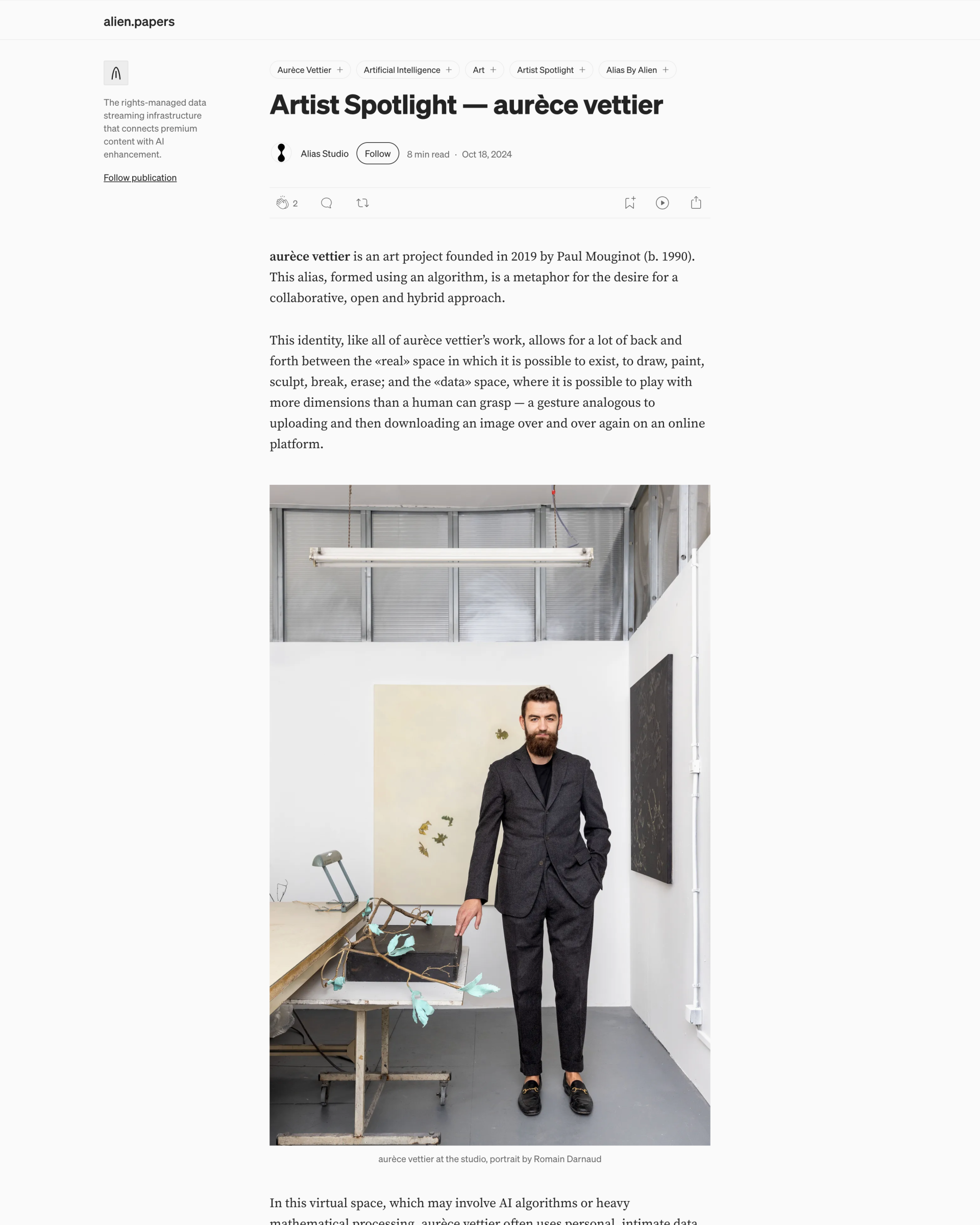
aurèce vettier is an art project founded in 2019 by Paul Mouginot (b. 1990). This alias, formed using an algorithm, is a metaphor for the desire for a collaborative, open and hybrid approach.
This identity, like all of aurèce vettier’s work, allows for a lot of back and forth between the «real» space in which it is possible to exist, to draw, paint, sculpt, break, erase; and the «data» space, where it is possible to play with more dimensions than a human can grasp — a gesture analogous to uploading and then downloading an image over and over again on an online platform.
Press enter or click to view image in full size
aurèce vettier at the studio, portrait by Romain Darnaud
In this virtual space, which may involve AI algorithms or heavy mathematical processing, aurèce vettier often uses personal, intimate data and explores new forms, which are then deployed as tangible objects, in close connection with many crafts.
The approach is not to consider the machine-generated elements as a set of finished works, but rather as raw material expanding conceptual possibilities and complementing the initial knowledge of art history.
ALIEN Q&A — AURÈCE VETTIER
What does it mean to be an artist at the age of AI?
I’m convinced that the artist’s place in the world, his role, is changing drastically. As opposed to what many of my artist friends claim, I don’t believe that AI is a medium in itself. It’s a tool, enabling expression on a wide range of physical and digital media. Nevertheless, this tool has extraordinary digestion capabilities, especially when you bother to train and deploy AI models tailor-made specifically for your artistic practice.
I very much enjoy working in close connection with the natural environment, but also with the extraordinary material of dreams: many natural phenomena are rapid or slow transformations, chemical reactions, and the same is true of dreams, which help us to digest and absorb a sometimes violent reality.
By trying to approach, to recreate a world that almost resembles the one we know, but not exactly, it’s this parallel in particular that I like to explore.
Left: aurèce vettier, a fish being decapitated by a sharp knife held by a hand; I am the fish, the knife and the hand, oil on canvas from an AI-generated image, oak frame, gold leaf, 20 cm x 30 cm, AV-2021-U-282 Right: aurèce vettier, Kalash Criminel emerging from a Rothko painting, oil painting on canvas from an AI-generated image, oak frame, gold leaf, AV-2021-U-293
Why did you join Alias and what do you use it for?
Among the artists who have been using AI for a long time, there are few who are interested in the idea of strongly personalizing their models, their working and exploration tools. We all know each other and talk to each other on a regular basis, especially through group shows around the world.
Artists don’t necessarily have to be engineers, yet they need to be able to easily surround themselves with tools or resources to push new technologies to their limits, question their limits and even have fun with them. A tool like Alias is welcome, as it lowers the barrier to entry for customizing such models.
Collaboration between AI and humans is on the rise. Can you discuss any collaborative projects you have done with machines and the outcomes of such collaboration? How do you navigate the balance between human intentionality an d the unpredictability of generative AI algorithms in your artistic practice?
In my work, I like to try to envision and reconstitute a world a little like our own, but in perpetual vibration with it. You can find this idea in literature as well as in mathematics: when you add a few dimensions to the reality we know, it’s possible to think more deeply, to make progress in solving certain complex problems, to progress in introspective questioning. In a way, we evolve in a universe similar to our own, but freed from certain rules and constraints. Sometimes, this also allows us to rediscover the simplicity of childhood, epiphanies and the blatantly obvious.
When we need to return to our reality, we then carry out what in mathematics is called a projection: we choose to lose some of these extra dimensions, and therefore information, but from an angle that we choose.
As an artist, this is really what fascinates me about using artificial intelligence: I personalize my models to a high degree, by training them on personal, even intimate data, and this allows me to have a kind of introspection assistant. Thus, in my body of work Circular Ruins (2022) and le travail des rêves (2024), I use a text-to-image artificial intelligence trained on all my photos, from childhood to the present day, in an attempt to represent dreams.
Exhibition view: le travail des rêves, set of 100 paintings depicting dreams, based on a bespoke AI trained on aurèce vettier’s photographic archives, from childhood to the present. Galerie Bigaignon, Paris, 2024. Photo: Romain Darnaud
Right from the start, this attempt is obviously doomed to failure, but when my models send me back images based on descriptions of dreams I’ve given them, I rediscover the colors of my childhood, shapes that interest me, but also a kind of serendipity that never ceases to amaze me, and keeps me going.
Generative AI has opened up new avenues for artists and creators. What do you think are the most exciting possibilities this technology offers? How do you see the role of generative AI evolving in the creative industry in the coming years?
Today, numerous tools and interfaces enable a wider public to understand the possibilities of generative AI. These tools are being used by a growing number of users, but their use is still far from widespread, and there is still a great deal of research to be done in this field. What’s more, companies are realizing that the simplistic use of off-the-shelf models, without customization, does not allow them to make the most of the power of this technology.
It’s the same in art: without adjusting artificial intelligence models to an artist’s aesthetic or conceptual ecosystem, it’s difficult to unfold a distinctive story.
Get Alias Studio’s stories in your inbox
Join Medium for free to get updates from this writer.
Enter your email
Subscribe
Remember me for faster sign in
What excites me about generative AI is precisely not the ability of these tools to generate content, because we’re already in a context of overabundance, we have more writers than readers, so what’s the point of adding yet another voice, derived via a generalist model, to the cacophony?
On the other hand, generative AI also makes it possible to digest large volumes of data and extract a kind of quintessence from them, enabling us to switch from one medium to another, from text to image, from image to video and so on. These are the modalities on which I focus my artistic research.
Press enter or click to view image in full size
aurèce vettier x Katarzyna Cichy, chrysodryas (sent by her, Anjou), Body in bronze gilded with gold, set with pale blue sapphire, dark blue sapphire, dark blue sapphire, white topaz, pale blue sapphire ; Wings with unique AI-generated patterns, archival pigment print on fibred Korean paper, AV-2024-U-569-KC
Some argue that AI could replace human creativity. What are your thoughts on this? Do you see AI as a collaborator or a competitor to human artists?
I understand why this question is being asked, especially since the 2020s. Until now, when an artist used computer technology, it was often to generate a kind of raw material, which was then transformed and transformed through many subjective choices, before resulting in a work of art.
Today, it is increasingly the case that the algorithm is the work itself, and that the works purchased by collectors are mere manifestations of this algorithm. In this sense, the artist may be choosing to delegate more creative freedom to the machine. But it’s a different mode of interaction, and I’m not convinced that it will spread to the entire art world.
Are there any specific trends or developments in the field of generative AI art that you find particularly exciting or promising?
Even though technologies have evolved and enriched considerably over the last few years, I remain fascinated by the possibilities offered by GANs (Generative Adversarial Networks) and, like Bard Ionson or Sofia Crespo, I continue to use them, notably in my recent series of butterfly sculptures — to generate their little wings.
As for models for switching from text to image, from text to video or from text to 3D, from the outset I’ve always found this type of interaction a little suspect.
As an artist, and even as a designer, it’s rarely possible to describe exactly what you want in the form of text, and besides, if you knew how to do it, you wouldn’t need to make paintings, sculptures or any other kind of creation.
Often, we arrive at work through trial and error, by taking shortcuts, or conversely by concentrating for many years on a single gesture.
In short, I think the most promising thing about artificial intelligence is the emergence of new possibilities for interaction with its tools: inpainting and outpainting, the use of voice to make multiple micro-corrections to a work in progress, for example, and the transition from a sketch to an image, and why not all in real-time?
Exhibition view of FINE PRINT, a group show gathering aurèce vettier and Ana Maria Caballero at LOAD Gallery in Barcelona, 2024
When a new technology or feature comes out, I of course try to take an interest in it and study it, because I’m very curious by nature, and I like to explore. On the other hand, I’m rarely in a hurry to be the first to use this or that technology, and I wait to see how it fits into the overall story I want to tell. This story is always in the back of my mind, and that’s what’s most important to me: finding a form of balance, of rightness, so that all the works are connected to each other in some way, and form a coherent ecosystem, both conceptually and aesthetically.
What role do you think artists should play in shaping the legal and regulatory frameworks governing AI and creativity?
I believe that artists have absolutely no role to play in creating a legal framework for technology.
Through strong, emblematic works, performances and actions, they are already pushing technologies to their limits, and asking questions, often a few years ahead of their time. This is nothing new: many questions about the interaction between man and machine were already raised by artists in the 50s and 60s, and today, many artists are asking how to reconcile the usefulness of technology with its negative externalities while preserving an intimate relationship with nature.